
Common sense or suppression? Testing U.S. voter ID rhetoric against global realities
by- Scott Kovacs
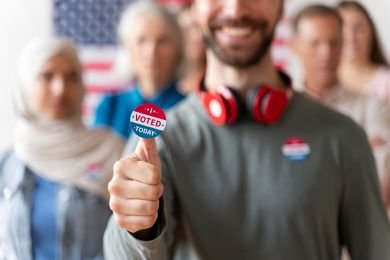
The debate over election integrity and ballot access has become one of the most polarizing fixtures in modern American politics. While congressional Democrats frequently condemn strict voter ID mandates and proof-of-citizenship requirements—even likening them to historic voter suppression tactics—proponents argue these security measures are essential to safeguarding the principle of "one citizen, one vote." Interestingly, this fierce domestic dispute stands in sharp contrast to global practices. Around the world, the vast majority of sovereign nations treat voter identification not as an exceptional hurdle, but as a baseline standard for democratic participation.
Democrats baselessly argue that strict voter ID laws cause voter suppression, disproportionately disenfranchise minority and low-income voters, and address a statistically rare problem of voter fraud. Party figures have publicly discussed these concerns during legislative debates on voting requirements. Following Supreme Court rulings that weakened the Voting Rights Act of 1965, House Democratic Leader Hakeem Jeffries argued that some lawmakers have unleashed "Jim Crow-like tactics" to restrict ballot access. They are not! It is a misleading comparison that some people believe because he keeps pushing it. Read about Jim Crow Laws here.
House Representative Joe Morelle and other congressional Democrats have opposed federal photo ID mandates, arguing such measures can negatively impact turnout among disadvantaged groups. Legislative proposals involving proof-of-citizenship requirements are viewed by critics as placing an excessive burden on eligible voters who may not readily possess documents like passports or birth certificates. Using this excuse for the last ten years has given people an ample amount of time to get their paperwork together if they are interested in voting. Critics argue that in-person voter impersonation is rare, making strict ID mandates an unnecessary hurdle, even though one illegal vote is too many!
These are the same people that rolled out the red carpet for illegal immigrants during the Biden administration, most probably an effort that they had hoped would lead to more voters, people who would remember who let them into the country. Jeffries heavily criticized the Republican-backed SAVE Act, calling it an electoral strategy rooted in voter suppression rather than true election security. Jeffries famously stated that "Jim Crow may be dead, but he has still got some nieces and nephews who are alive and well."
But, throughout the world, at least 176 countries and jurisdictions worldwide require some form of identification to vote, according to global electoral datasets tracking voter ID laws. This baseline expectation is the standard international norm rather than the exception. In Europe, out of 47 European nations, 46 require a government-issued photo ID at the polls. The United Kingdom historically served as a partial exception but has transitioned toward mandatory photo ID requirements for most elections. In the Americas, Mexico, Canada, and all 12 sovereign nations in South America require government-issued identification to cast a ballot.
In Africa and Asia, these regions have some of the highest global rates of strict photo ID or biometric ID mandates (such as fingerprints or retina scans), often implemented during post-independence electoral design to cultivate public trust.
While identification is a global standard, how countries manage it differs significantly from the system used in the United States. The vast majority of democracies that strictly require photo ID also maintain mandatory national identity cards. Because the government automatically issues these cards to all eligible citizens upon reaching a certain age, requiring them at the polls is rarely exclusionary or controversial. There is a small number of countries, such as New Zealand, Switzerland, and parts of the UK, that traditionally rely on verifying a voter's name and residential address directly against a universal citizen register rather than checking physical ID cards.
Ultimately, the data reveals that verifying a voter's identity is an overwhelming international norm, utilized by dozens of nations across Europe, Africa, Asia, and the Americas to foster public trust in election outcomes. However, the critical distinction lies in implementation: while foreign democracies often mitigate access issues through automatically issued national identity cards, the United States remains entangled in structural and partisan gridlock over how voters obtain documentation. Until the U.S. reconciles its infrastructure with these global standards, the friction between ensuring absolute ballot security and maintaining broad voter access will continue to dominate the legislative landscape.
Scott Kovacs is a writer and editor for Patriotic Way. He primarily writes about politics, patriotism, and truth in reporting. Previously, he worked in the medical field as a Registered Nurse for 27 years.
© 2026 Patriotic Way. All rights reserved. All rights reserved.
Patriotic Way Home